Physical Address
304 North Cardinal St.
Dorchester Center, MA 02124
Physical Address
304 North Cardinal St.
Dorchester Center, MA 02124

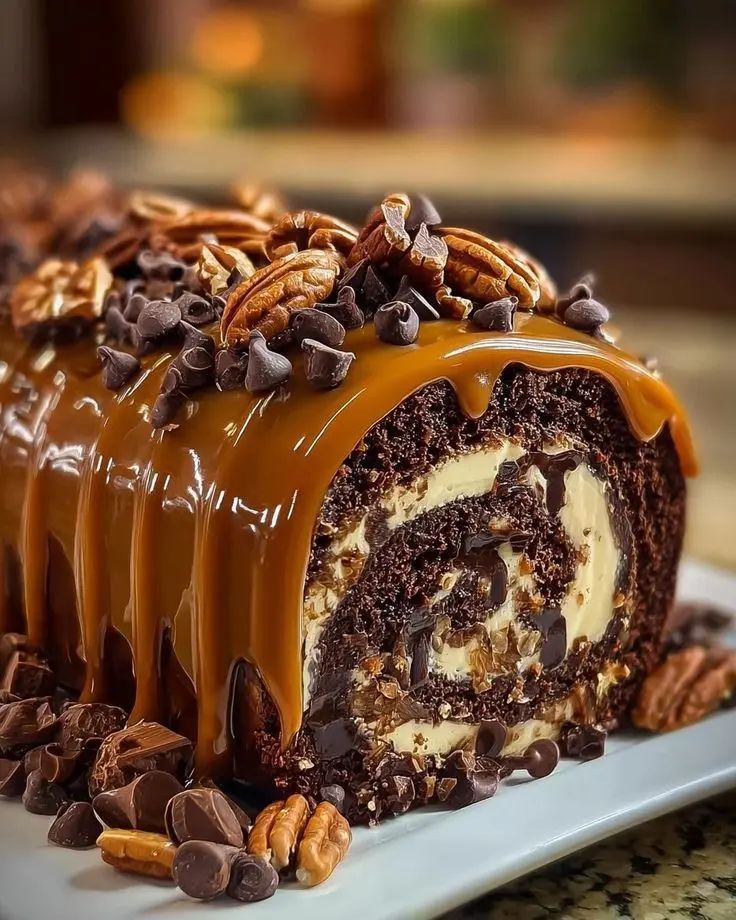
There are desserts that taste wonderful. And then there are desserts that stop people in their tracks the moment they see them on the table. This Chocolate Caramel Pecan Swiss Roll Cake — swirled, glossy, and loaded with toasted pecans and ribbons of golden caramel — is absolutely the second kind.
Cut into it and you get that dramatic spiral reveal: dark chocolate sponge wrapped around a cloud of vanilla cream filling, the whole thing draped in a glossy caramel glaze, scattered with chocolate chips and whole toasted pecans. It looks like it came from a professional bakery. It tastes even better than that.
If you have never made a Swiss roll before, this guide will walk you through every step without leaving anything to chance. And if you have made one before and had it crack — this time, you will know exactly why that happens and how to prevent it entirely.
The term Turtle in baking refers to the combination of three specific flavors: chocolate, caramel, and pecans. This trio was named after the famous Turtle candy — a pecan cluster coated in caramel and dipped in chocolate — which became a beloved American confection in the early twentieth century.
When you bring those same three elements into a Swiss roll format, something special happens. The light, airy chocolate sponge gives the richness of the caramel and pecans a place to breathe. The cream filling adds a cool, neutral contrast. And the combination of textures — soft sponge, silky cream, crunchy nuts, and sticky caramel — makes every single bite genuinely interesting from the first to the last.
This is not just a cake. It is a flavor experience built around one of the most reliable combinations in the history of baking.
Organize your ingredients by component before you begin. The sponge moves fast once it comes out of the oven — having everything ready means you can roll it at exactly the right moment.
| Ingredient | Amount | Notes |
|---|---|---|
| Eggs (room temperature) | 4 large | Separated |
| Granulated sugar | ¾ cup / 150g | Divided |
| All-purpose flour | ⅓ cup / 45g | Sifted |
| Unsweetened cocoa powder | ¼ cup / 25g | Dutch-process preferred |
| Baking powder | ½ tsp | |
| Fine salt | ¼ tsp | |
| Pure vanilla extract | 1 tsp | |
| Powdered sugar | 2 tbsp | For rolling in the towel |
| Ingredient | Amount | Notes |
|---|---|---|
| Cream cheese (softened) | 225g / 8 oz | Full fat, room temperature |
| Powdered sugar | 1 cup / 120g | Sifted |
| Heavy whipping cream | ½ cup / 120ml | Cold |
| Pure vanilla extract | 1½ tsp |
| Ingredient | Amount | Notes |
|---|---|---|
| Granulated sugar | 1 cup / 200g | |
| Heavy cream (warm) | ½ cup / 120ml | Warm before adding |
| Unsalted butter | 3 tbsp | Cut into cubes |
| Fine sea salt | ¼ tsp | Balances sweetness |
| Item | Amount |
|---|---|
| Whole toasted pecans | ½ cup / 60g |
| Roughly chopped pecans | ¼ cup / 30g |
| Mini chocolate chips | 3 tbsp |
| Dark chocolate drizzle (optional) | 50g melted dark chocolate |
🥜 Pecan tip: Toast your pecans before using them — spread on a dry pan over medium heat for 4–5 minutes, shaking occasionally, until fragrant. Toasting deepens their flavor dramatically and gives them a crunch that holds up against the soft sponge and caramel.
Preheat your oven to 375°F / 190°C. Line a 10×15-inch jelly roll pan with parchment paper and lightly grease it. This size is important — a standard sheet pan will spread the batter too thin and produce a sponge that tears rather than rolls.
Separate your eggs carefully. Beat the yolks with half the sugar until they are thick, pale, and fall in a ribbon from the beater — about 3 to 4 minutes. Stir in vanilla.
In a separate clean bowl, beat the egg whites to soft peaks, then gradually add the remaining sugar and beat to glossy, firm peaks. Do not over-beat — stiff peaks lose their flexibility and make the sponge harder to roll cleanly.
Sift the flour, cocoa, baking powder, and salt directly over the yolk mixture. Fold in gently. Then fold in the egg whites in three additions, keeping the batter as light as possible. Work deliberately — deflated batter produces a flat, dense sponge that cracks on rolling.
Spread the batter evenly into the prepared pan and bake for 10–13 minutes. The sponge is done when the top springs back lightly when touched and the edges just begin to pull from the sides.
The most important thing you will do in this entire recipe happens in the first two minutes after the sponge comes out of the oven. Do not wait. Do not let it cool first.
Lay a clean kitchen towel flat on your counter and dust it generously with powdered sugar. Turn the hot sponge directly onto the towel, peel away the parchment paper from the back, and immediately roll the sponge up inside the towel — starting from one of the short ends.
Set it seam-side down on a cooling rack and leave it to cool completely in the rolled position. This trains the sponge into its rolled shape while it is still pliable. Trying to roll a cold sponge is what causes cracking — this step prevents that entirely.
Beat softened cream cheese until smooth with no lumps at all. Add sifted powdered sugar and vanilla, beating until combined. In a separate bowl, whip cold heavy cream to soft peaks. Fold the whipped cream into the cream cheese mixture until you have a smooth, spreadable filling with a light texture.
Refrigerate for 15 minutes while the sponge finishes cooling.
Carefully unroll the cooled sponge from the towel. Spread the cream filling across the entire surface, going right up to the edges but leaving a 1cm border at the far short end — this prevents the filling from squeezing out when you re-roll.
Roll the sponge back up firmly — but not so tightly that the filling pushes out. Place seam-side down on your serving platter. Refrigerate for at least 1 hour to set the filling before applying the glaze.
Heat granulated sugar in a heavy-bottomed saucepan over medium heat. Do not stir — just swirl the pan occasionally as the sugar melts and turns amber. The moment it reaches a deep golden-amber color, remove from heat immediately.
Carefully pour in the warm cream — it will bubble aggressively. Stir quickly. Add the butter cubes and salt and stir until the glaze is completely smooth. Cool for 8–10 minutes until thick but pourable.
Pour the caramel glaze slowly and generously over the top of the chilled Swiss roll, letting it run naturally down both sides. While the caramel is still slightly tacky, press whole toasted pecans down the center of the roll and scatter chopped pecans and mini chocolate chips across the surface.
Drizzle melted dark chocolate over everything in thin back-and-forth lines for the full Turtle effect. Refrigerate for a final 20 minutes before slicing and serving.
🔪 Slicing tip: Use a long, sharp serrated knife and cut with a gentle sawing motion rather than pressing down. Pressing compresses the filling and distorts the spiral. Wiping the blade clean between slices keeps each cut looking sharp.
Your Chocolate Caramel Pecan Swiss Roll keeps well, covered, in the refrigerator for up to 4 days. The sponge stays soft and the filling holds its texture throughout. For best results, apply the caramel glaze and fresh pecan garnish on the day you plan to serve it rather than days before — the caramel absorbs into the sponge over time and loses its glossy appearance.
The unglazed, filled roll freezes well for up to 6 weeks. Wrap tightly in plastic wrap and then foil. Thaw overnight in the refrigerator, then glaze and garnish fresh before serving.
Cracking almost always means the sponge cooled before it was rolled. The sponge must be rolled in the towel immediately after it comes out of the oven while the gluten is still warm and flexible. Once it cools flat, rolling causes the surface to break. If your sponge does crack slightly, the caramel glaze and garnish will cover surface cracks beautifully — so do not panic.
Yes, a thick, good-quality store-bought caramel sauce works perfectly as a time-saving substitute. Warm it slightly before pouring so it flows naturally over the roll. Homemade caramel gives you more control over thickness and saltiness, but the store-bought version produces a very acceptable result.
Three things: a sharp serrated knife, a sawing motion instead of pressing down, and wiping the blade clean between every slice. Chilling the filled roll for at least an hour before slicing also firms the cream and keeps the spiral defined rather than squashed when you cut.
Yes. Bake the sponge, roll it in the towel while hot, and once fully cooled, wrap the whole thing — still rolled in the towel — in plastic wrap. Keep refrigerated for up to 24 hours before unrolling, filling, and finishing. This is a great make-ahead strategy for larger gatherings.
A Chocolate Caramel Pecan Swiss Roll Cake is the kind of recipe that builds your confidence in the kitchen. It teaches you how to handle a sponge, how to make caramel from scratch, and how to build a layered dessert with real visual drama — skills that carry over into everything else you bake.
And when you set it on the table, whole caramel-dripping and pecan-crowned, and make that first slice to reveal the spiral inside — you will already know the answer to every question the room is about to ask you. Yes, you made it yourself. Yes, the caramel is homemade. And yes, you will absolutely be making it again.